The madness behind March Madness
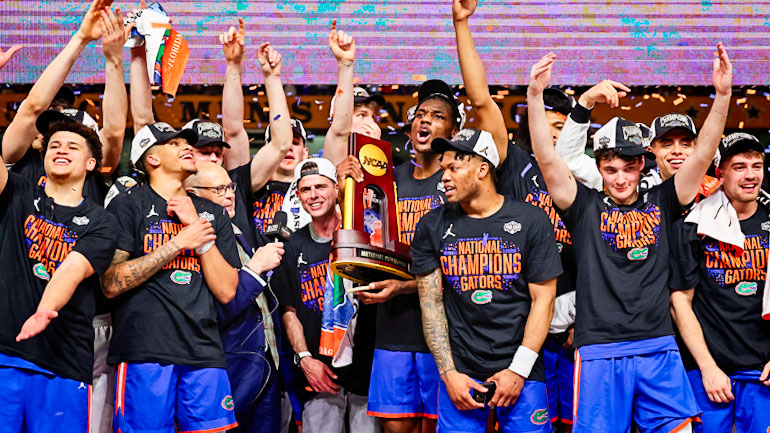
The University of Florida celebrating the national championship victory last year. This was the Gators third national title in program history.
 Every year at this time, college basketball fans wait with great anticipation for the NCAA Division I mens basketball championship tournament, commonly known as March Madness. While it has evolved into one of the most popular and well-known sporting events in the United States, many people may not know of its humble beginnings and remarkable history, economic impacts and notable achievements.
March Madness has a rich history dating back to 1939 when the first NCAA mens basketball tournament was held, featuring just eight teams. The University of Oregon won the inaugural championship by defeating Ohio State University 46-33.
The term “March Madness” originated in 1939 in Illinois, where it was used to describe the state’s high school basketball tournament. It became associated with the NCAA tournament in 1982 when CBS broadcaster Brent Musburger used it during the tournament coverage. The very popular “One Shining Moment,” the anthem that highlights the best moments of the tournament, first aired following the NCAA mens basketball tournament in 1987.
The tournament format has evolved significantly over the years. In 2011, the field expanded to 68 teams, the number it still has today.
Teams are selected through automatic bids (conference champions) and at-large bids (top teams not winning their conference). The tournament progresses from the First Four, to the First Round, Sweet 16, Elite 8, Final Four, and culminates to the championship game.
One of the most anticipated parts of March Madness is when the underdog or Cinderella teams defy the odds and pull off incredible upsets against elite blue-chip teams. Some memorable examples include UMBC (University of Maryland, Baltimore County) defeating No. 1 seed University of Virginia 74-54 in 2018 or VCU (Virginia Commonwealth University) going from the First Four to the Final Four in 2011.
Fans are part of the madness too: an estimated 60 to 100 million brackets are filled out each year. (See the E Guide insert for 2026 bracket.) The odds of filling out a perfect bracket are a staggering 1 in 9.2 quintillion. The closest was in 2019, when a fan correctly picked the first 49 games before finally missing one.
Over the years, a few schools have been regulars at March Madness: UCLA holds the record for the most championships with 11 national titles. The University of Kentucky (UK) has made 59 appearances to the tournament, and the University of North Carolina holds the record for making it to the Final Four 21 times.
Some legendary individual performances that deserve attention include Notre Dame’s Austin Carr setting the all-time tournament record with 61 points in a single game in 1970; UCLA’s Bill Walton scoring 44 points and leading his team to another title in 1973, and Christian Laettner’s iconic shot for Duke University against UK in 1992.
March Madness games begin with the First Four on Tuesday, March 17.
For more information and the 2026 March Madness tournament schedule, visit ncaa.com/march-madness-live or cbssports.com/watch/cbs-sports-network.
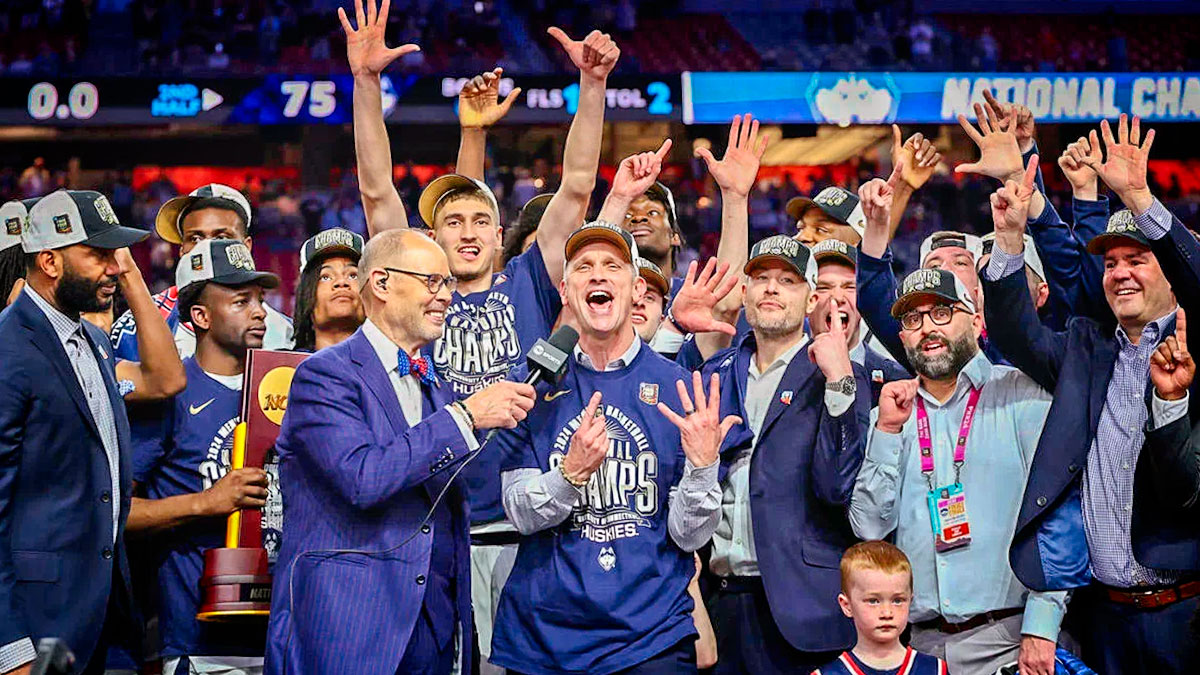
The University of Connecticut rejoicing in 2024 after winning March Madness. The Huskies have won five national championships.
By Sara Goodwin; photos courtesy of Tarheel Times and CBS Sports