July 4, 2026: What to know for our nation’s 250th birthday (Part 1 of 5)
This 4th of July will be different. Off the charts. Americans will come together, setting daily routines aside to whoop it up in a semi-quincentennial gala to contemplate 250 years of achievements (and struggles) since our nation’s founding. It will be an epic celebration. Beginning here, with this month’s pages and continuing in the four issues to follow, we will highlight the events that brought us to the moment.
Beginning in the year 1607 and through 1732, 13 separate colonies were formed on the Atlantic coast of North America, the first permanent settlement being at Jamestown, Virginia. By 1775, the colonists had prospered through trade, both transatlantic and with the indigenous people, with a total population reaching 1.5 million by 1770. Farmers made up 90% of the population. The colonies were so successful economically, they made up 40% of the British Empire’s GDP.
Given their economic capacities, the British monarchs chose to squeeze more money from the colonists via taxation, especially because England was deeply in debt from the mid-century French and Indian War, ending in 1763. First came the Sugar Act of 1764, taxing sugar, coffee and molasses. Then came the Stamp Act, requiring paper used in commerce be stamped with the British Crown emblem. Next, the Townshend Act taxed common items manufactured in Britain.
These taxes set the colonists tongues to chattering in pubs and other social venues. Tension built, especially in the northeast colonies, laying the groundwork for the Sons of Liberty. These 150 men were some of the most exercised and influential in the area.
In March 1770, British soldiers who guarded the Boston Customs House fired into a crowd, escalating local issues and disagreements to new levels of mayhem. Known rather quickly as the “Boston Massacre,” eight soldiers and four citizens were indicted for murder.
By 1773, protests claiming taxation without representation took an especially acrimonious turn when Sons of Liberty members, disguised as Mohawk Indians, dumped 342 cases of tea into Boston Harbor. Not long after, the British created the Intolerable Acts of 1774. With them, they closed Boston Harbor, revoked the Colony’s charter for self-government, required citizens to accommodate British soldiers on private property and allowed British citizens to be tried of a crime back in the British Isles—a “safe-haven.”
Under title of “The First Continental Congress,” and in an effort to temper passion on both sides, the colonies sought to have the Intolerable Acts repealed. It was the first time the colonies acted in concert and in an appeal to the British government.
By April 1775, Massachusetts was a tinder box, merely waiting for a spark. So when colonists learned of an English operation to plunder their military supplies at Concord, they chose to stop the Brits militarily. On the night of April 18, Paul Revere and others rode through the streets and alleys of Boston warning of the clash to come.
Sunrise of April 19 brought the forces together at Lexington in a small skirmish. One shot rang out, and then others. The outnumbered colonists retreated, regrouped and met the British again at Concord at the Old North Bridge. This time the Patriots had an overwhelming advantage. The English were roundly driven back, eventually returning to Boston that evening.
Informally, the Revolutionary War had begun.
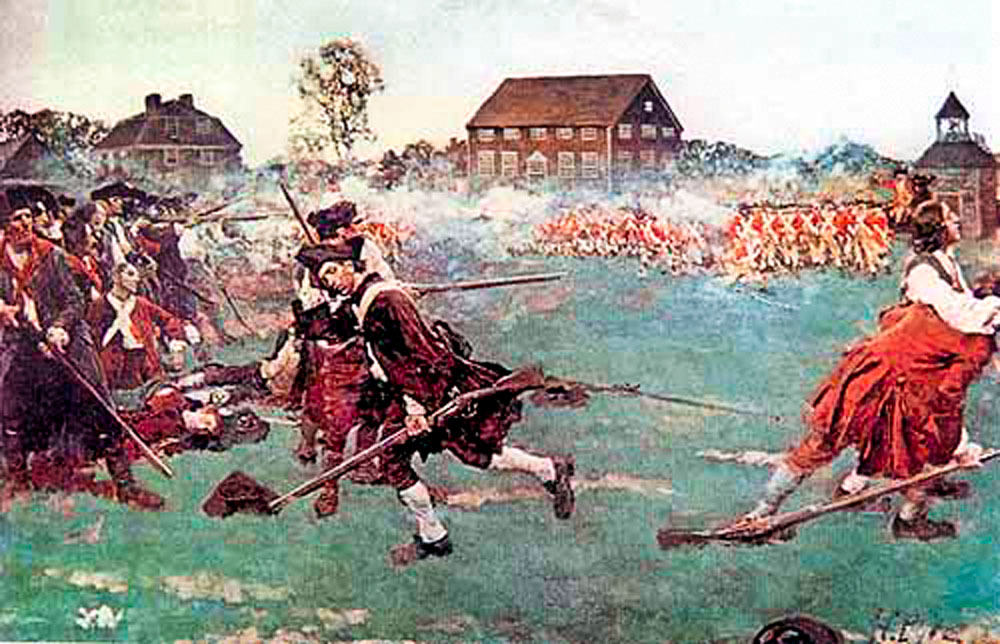
The Battle at Lexington Commons was the first military engagement of the American Revolutionary War. On April 19, 1775, colonial militia and British troops faced off, which later became known as “the shot heard ‘round the world.” This painting by Howard Pyle is titled “Fight on the Lexington Commons.”
By Joe Gschwendtner; courtesy images