A mouse that roared: 1775-1850 (Part 2 of 5)

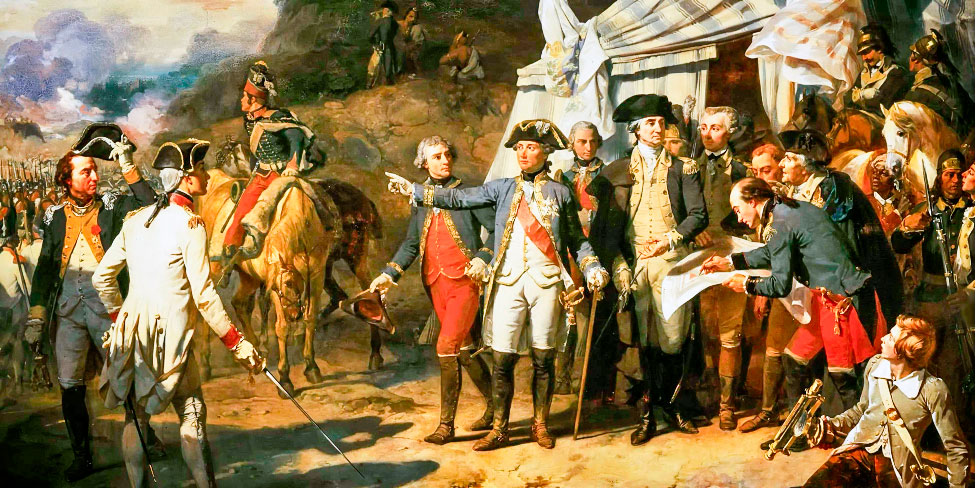
The 1836 oil painting Siege of Yorktown attributed to Henry LeGrand, after Louis-Charles-Auguste Couder.
That the Revolutionary war began after the Battles of Lexington and Concord was unsurprising. The British monarchy did not tolerate challenges to its authority. American pioneers were upstarts by definition, resentful of having their new world freedoms trampled. Thus, for the colonists, what began as a fight for their rights quickly became one for their sovereignty.
The Battle of Bunker Hill followed in June of 1775, notable in that the colonists held their own against British regulars in Boston inflicting heavy casualties. In June, the Second Continental Congress of state delegates appointed George Washington as Commander of the Continental Army. Even so, the delegates also petitioned for repeal of the Intolerable Acts. King George rejected it roundly, declaring the colonies in open rebellion.
In 1776, Thomas Paine’s Common Sense booklet circulated among the colonies, making the case for full independence from Great Britain. With it, public opinion shifted and a committee, under Thomas Jefferson, drafted the Declaration of Independence. Signed and made public on July 4, 1776, key words addressed our “inalienable rights to life, liberty and the pursuit of happiness,” and established the United States as a sovereign nation.
The Revolutionary War would last eight years. At first, our prospects were poor, as George Washington’s Army was a rag-tag militia with no battle experience up against a well-trained British army with conditioned soldiers and modern equipment. Things were bleak until the Battle of Saratoga in New York in 1777.
British General John Burgoyne’s battle plan was to separate the New England colonies from their Middle Atlantic brethren marching south from Canada. Ironically, the three-week battle saw the colonists cutting off Burgoyne’s logistics and surrounding him in a decisive victory. It was the war’s turning point. As a result, King Louis the XVI of France turned support to Americans.
Despite French forces, there would be no quick winners. Behind the scenes, American rag-tag soldiers were trained by German General Baron Friedrich von Steuben. Colonial forces had to be imaginative and bold, with hit-and-run tactics. The harsh winter at Valley Forge tested Washington’s army.
In 1781, British General Charles Cornwallis chose to position his forces near the Virginia coastline for necessary provisions. A combined French and American naval and land force outsmarted and then besieged Cornwallis’s troops at Yorktown, resulting in the surrender of his entire army, effectively ending the war. In 1783, the Treaty of Paris was signed, recognizing the United States as an independent nation.
Previously governed by the Articles of Confederation, colonial leaders drafted our Constitution and executed it in Philadelphia in 1787. Ratified by the states in 1878, it was an epic document defining our freedoms. In 1789, George Washington was inaugurated as the country’s first President. Over the next 50 years, the United States would acquire land from France and Spain that would double its size.
In 1803, the United States procured the Louisiana Purchase from France for $15 million dollars, or 3 cents an acre, which doubled the size of the country. Lewis and Clark were commissioned in 1804 to explore the new territory. Then in 1812, we declared war on Great Britain again over trade and territorial issues and high seas shenanigans. It ended with the Treaty of Ghent in 1815.
In 1820, with racial tensions rising between northern and southern states, Congress passed the Missouri Compromise, which was an attempt to ease tensions between free and slave states.
The Monroe Doctrine was established in 1823, asserting American dominance in the Western hemisphere. The Mexican-American War was fought from 1846 to 1848 and with the Unites States win, the prize was the land masses of California, Nevada and Utah; most of Arizona and New Mexico and parts of Colorado and Wyoming. By 1850, population of the United States had reached 23 million.
By Joe Gschwendtner; courtesy photo