A politician, prospector and developer

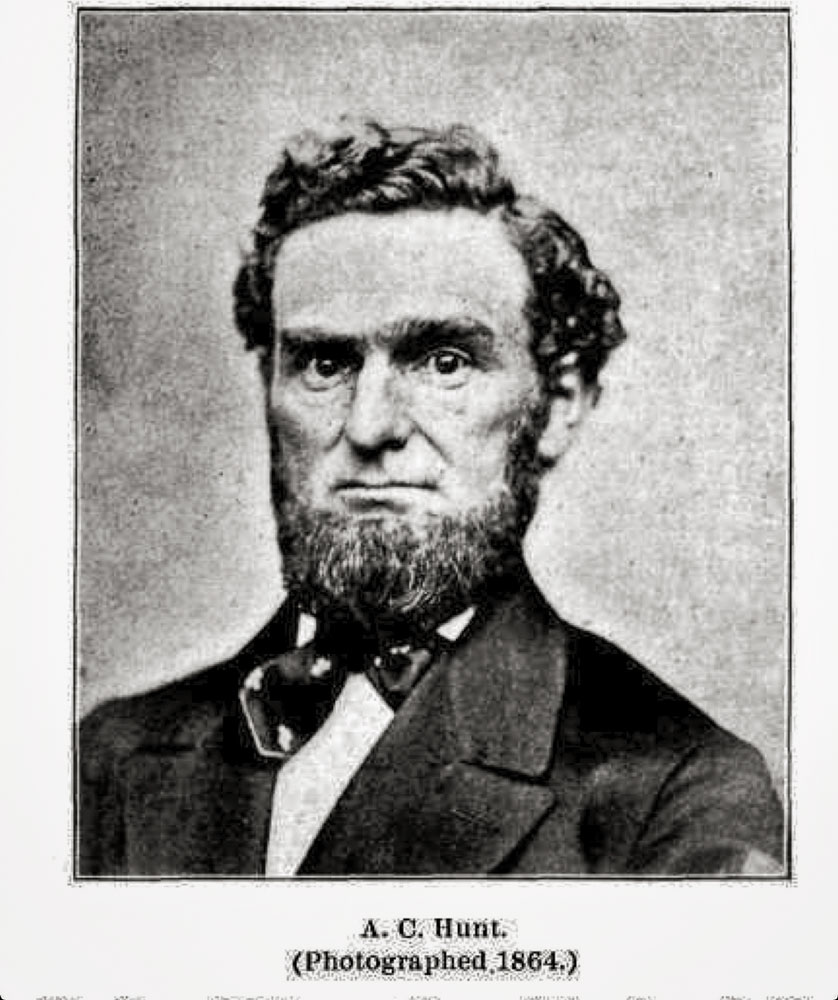
Throughout his life, Alexander Cameron “Cam” Hunt wore many hats: mayor, governor and land developer in southeast Douglas County, to name a few.
Governor Alexander Cameron “Cam” Hunt had an eye for real estate, building his final home on a mountain in southeast Douglas County bearing his name.
Born in 1825 in New York City, Cam’s family moved to Freeport, Illinois. His mom taught him to cook; his father to build homes and to play well with others, among them Native Americans in the area. In 1849, Cam went to California, came back successfully to Illinois with more than gold dust, opening a produce and grain dealership in 1851.
Young Ellen Elizabeth Kellogg, descendant of a Mayflower signatory, caught Cam’s eye and they married. By 1856, Cam was elected the mayor of Freeport. Unfortunately, he was caught up in the Panic of 1857 and the resulting depression that followed, which cost him his business. Still a risk taker, Cam learned of Colorado gold discoveries in 1858, and he and Elizabeth joined a Kansas City westward wagon train.
To note that Elizabeth was unhappy on the trail was an understatement. In her diary she noted, that she would never move again. Making matters worse, suffering from a bacterial skin infection, she hunkered down inside the wagon for the whole of the journey.
Finding no gold, they slogged their way to Auraria where Cam built a mud and log cabin with no windows and a dirt floor. A rough neighborhood early on, settlers observed Cam’s strong leadership and chose him to be vice-president of the Auraria Town Company. When Auraria later merged with Denver, he built the first brick house in the Mile-High City.
Cam’s proven talent in negotiating disputes and reaching solutions led to his rapid rise in politics, beginning with his elevation to Judge of the Vigilante Committee of the Territory. Then came a posting as United States Marshal for the Territory, Ex-officio Superintendent of Indian Affairs and yet later, Territorial Governor (of Colorado) in 1867. In that position Cam engineered an agreement with the Ute Indian Tribe to vacate all lands east of the 107th meridian, the north-south line of longitude that runs through western Colorado and northern New Mexico.
While serving as governor, Cam somehow fell into disfavor with President Ulysses S. Grant and was relieved of his title in 1869. Grant would later apologize to Cam when he realized his wrongheadedness. In recognition of Cam’s service to Colorado, the president gifted him a stallion, aptly named Peacemaker.
Never one to remain idle, Cam developed a relationship with General William Jackson Palmer. In 1873 and over the following five years, Cam began acquiring land, including a ranch due east of what was Huntsville (today’s Jellystone Park at Larkspur) at a higher elevation. Those who have seen it argue that it was the finest piece of real estate in our county. Cam’s original cabin still stands, tranquilly set within a grove of trees (pictured left).
In conjunction with General Palmer, Cam helped develop the Denver and Rio Grande Western Railroad. They seized on the concept of a narrow-gauge railroad, allowing trains to more easily transit the narrow, often sketchy, mountain chasms of the Rockies. Later, Cam (and 12,000 other employees) built the Mexican National Railroad, also narrow-gauge, some 2,000 miles from Laredo, Texas to Mexico City.
Cam died in 1894 at age 68 and is buried in Washington, D.C.’s Congressional Cemetery.
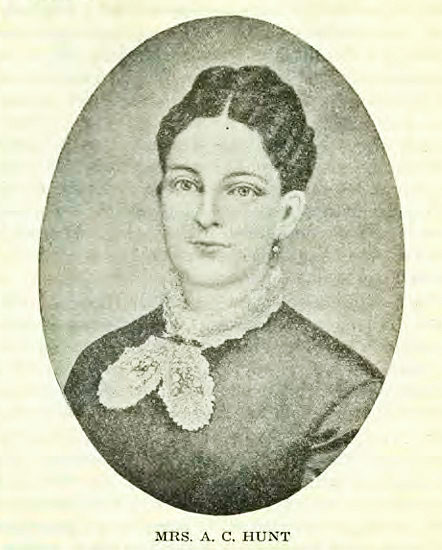
Ellen Kellogg Hunt came to Colorado with her husband, Cam, via a Kansas City westward wagon train.
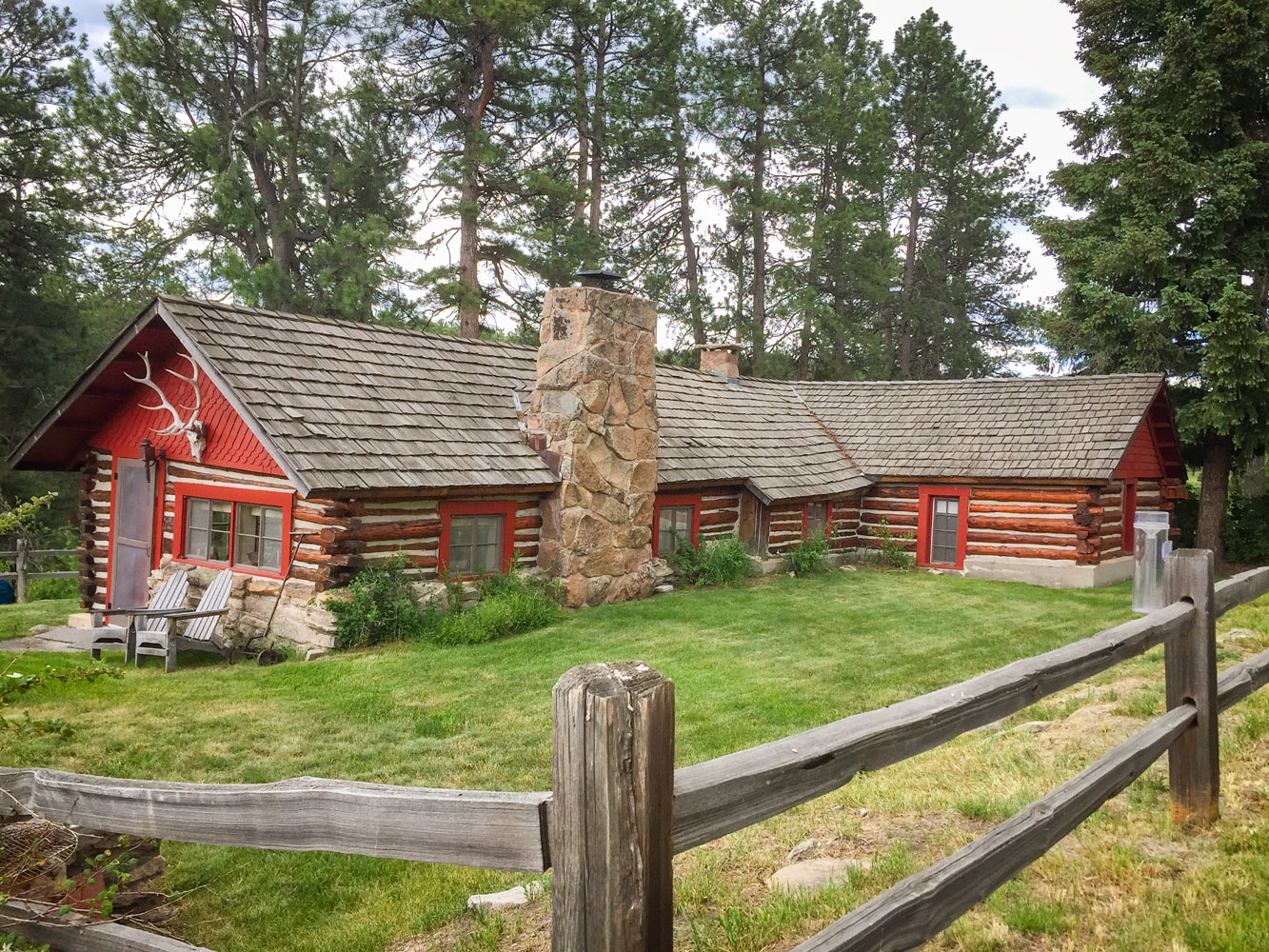
Nestled away on Hunt Mountain, Can Hunt’s retreat home still stands today.
Article and photo by Joe Gschwendtner; courtesy photos