Colorado living: State symbols & emblems, part 2
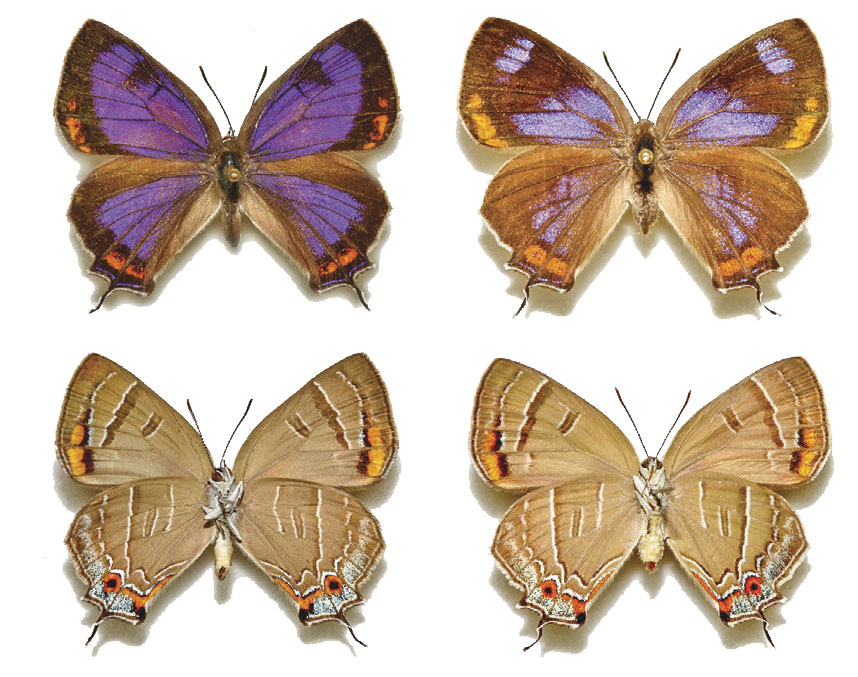
The distinctive purple and orange coloration of the upperside of the Colorado Hairstreak Butterfly’s wings is brighter on the male (upper left) than the female. The lighter underside colorations are nearly identical for both male (lower left) and female.
This month’s segment of Colorado’s official emblems and symbols looks at the official state insect: the Colorado Hairstreak Butterfly. This distinctively colored butterfly that lives in Gambel oak groves was adopted as the official insect in 1996, after urging from fourth graders across the state. Colorado was the 37th state to officially declare a state insect or butterfly.
The brightly-colored upper sides of the Colorado Hairstreak’s wings are purple, with a darker border and small orange spots. The undersides of the wings also have orange spots but are otherwise lighter in color, with no purple. Its wingspan is about 1.25 to 1.5 inches. Like other hairstreak butterflies, it has a delicate tail that extends from the hind wings. The “hairstreak” name likely stems from the wispy markings on the wings or from its thin tail.
Colorado Hairstreak butterflies are seldom found far from Gambel oak, the caterpillar’s foodplant. Castle Pines sits at roughly the northern limit of Gambel oak growth on the eastern slope, making it likewise the northern limit of the Colorado Hairstreak. The oaks’ range extends further north on the western slope, a little into Wyoming. The butterflies can be found in hills and canyons of 6,500 to 9,000 feet in elevation.
Throughout the late 1990s, the Colorado Hairstreak was very common in the Castle Pines and Castle Rock areas. However, a late-May cold snap in the early 2000s killed the new oak leaves, leaving the caterpillars without food. Over the following two decades, the butterfly populations along the Rampart Range recovered, but they have not yet been seen again in Castle Pines. While they might repopulate the area eventually, a similar late-May cold snap in the early 2020s again depleted the Rampart Range population.
Colorado Hairstreak butterflies do not migrate. The adults lay their eggs on the oak trees and feed on oak sap and sugary secretions from galls (tree bumps), and they get water from moist sand and from raindrops on leaves. Adults’ lifespans are up to 17 days for males and 21 days for females. The eggs are tiny, round and white. The caterpillars are about an inch long, green, and roughly cylindrical, with prominent ridges on their bodies, often adorned with fine hairs. Colorado Hairstreaks produce one generation per year.
Lepidopterist Dr. Andrew Warren, a butterfly and moth expert from the Hidden Pointe neighborhood, shared, “Colorado Hairstreak adults are generally rather reclusive. They spend most of their time just hanging out in the shade of Gambel oak trees. The best way to find adults during most of the day is to tap oak branches with a stick to flush them from one branch to another.” Adults are active in the mid-to late afternoons when clouds build before a thunderstorm. At such times, they might be seen flitting over the canopies of Gambel oak groves.
For more information, visit colostate.edu (search “hairstreak”), butterflies.org/thecoloradohairstreak and butterfliesofamerica.com/L/t/Hypaurotis_crysalus_a.htm.
By Susan Helton; photos courtesy of Andy Warren