Pine Grove becomes Parker: Part II

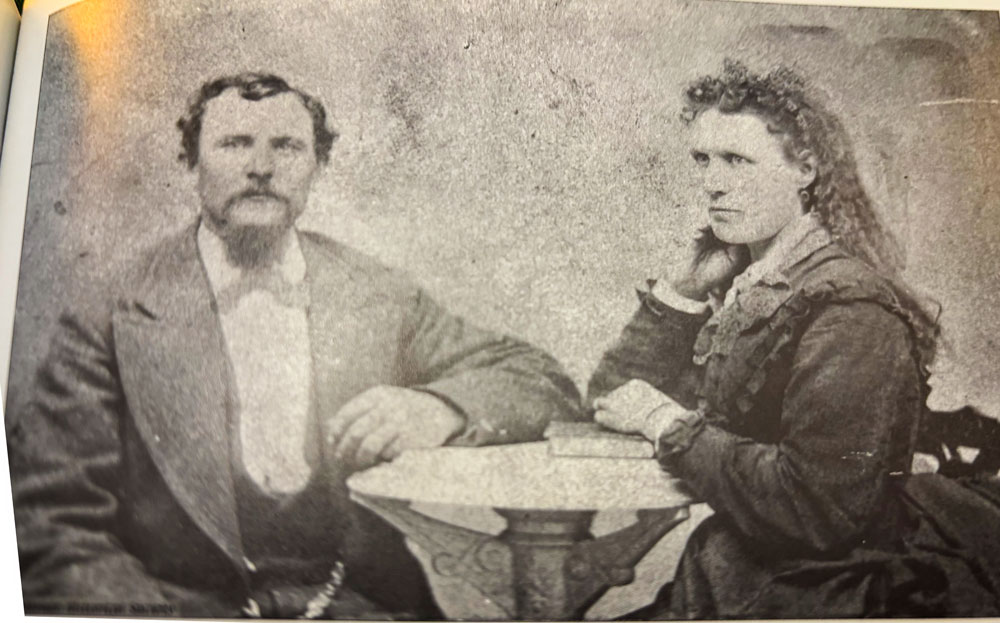
James Sample Parker, the town’s namesake, and his wife Mattie. As postmaster, naming rights were his privilege.
Pine Grove simmered early rather than grew. A mere transit point, freighting and lumber processing at Gomer and Foster’s Running Creek sawmill were its early sparks. George and Mary Long, whose vision was pivotal and would over time become the fulcrum of Parker history, lived nearby.
From our coverage last month, recall that the Longs purchased Alfred Butter’s post office from Mr. Goldsmith, moving it to the 20-Mile juncture (20 miles from Denver City) where the Smoky Hill Trail and Santa Fe Stage Line converged with the Territorial Road. Mary’s first-class cooking and George’s carpentry skills enhanced and completely transformed the location. Over six years of ownership,10 rooms were added. It prospered, becoming the place to go for hospitality in Pine Grove.
Married in Russellville, Colorado, John and Elizabeth Pennock Tallman lived east of 20-Mile in their two-room log cabin. Hearty and tough, they too saw a future for themselves in Pine Grove. Once a freighter, John ran cattle on their 160 acres and was partner with brother-in-law H.M. Foster at the sawmill. It is said that though he was a tough officer in initial Colonel Chivington’s command, he treated his ranch hands with great compassion.”
The Tallmans had other ventures, including a grocery business, alfalfa growing, and they were proprietors of the Elizabeth Hotel. Appointed county commissioner in 1888, John was instrumental in planning for the new county courthouse and was the first clerk and recorder of the county.
Back at 20-Mile, George and Mary inexplicably traded their 20-Mile House to LeGrande and Emma Doud Gould for “four span of mules” in 1870. The Goulds made enhancements and owned it for four years. Then, James Sample Parker, a Kiowa station manager and bullwhacker, got wind of its availability, buying it in 1874.
James and his wife Mattie took over operations, adding a blacksmith shop and general merchandise. Already a major locus of activity, 20-Mile was the town post office as well.
Of their children, James favored Edith. When necessary to rename Pine Grove per the postmaster’s prerogative since there was another town with the identical name in Colorado, James’s feelings surfaced when he proposed “Edithville.” Failing that, his ego and second choice––Parker––prevailed.
Deeply supportive of education, James was instrumental in building the town’s first school. Graciously, he funded the teacher’s first year salary. Mattie died 10 years after their marriage and James quickly remarried a local schoolteacher named Eva.
William and Elizabeth Newlin arrived from Minnesota in 1878 and bought the Tallman property. They brought the first shorthorn cattle to Colorado and grew ranch holdings to 720 acres. In 1898, they created the Newlin Cemetery.
In 1897, William and Annie O’Brien relocated to Colorado’s dry air for William’s health. His recovery mushroomed into their vocation. Buying the Allison Ranch, they turned a chunk of it into a tuberculosis/respiratory wellness center.
Latecomers Ed and Lena Pouppirt arrived in 1901. Ed’s father was French; Lena was from Arapahoe County. Dairy farmers, ranchers and later developers, they were immensely successful, their landholdings exceeding 7,000 acres, later to include the 20-Mile House property. Especially colorful, some suggested they were moonshiners during prohibition. Their home was “state of the art,” a dumbwaiter included. It was also among the first to be lit by acetylene gas.
By Joe Gschwendtner; photo courtesy of the Parker Area Historical Society