A genius found a genus… in our backyard
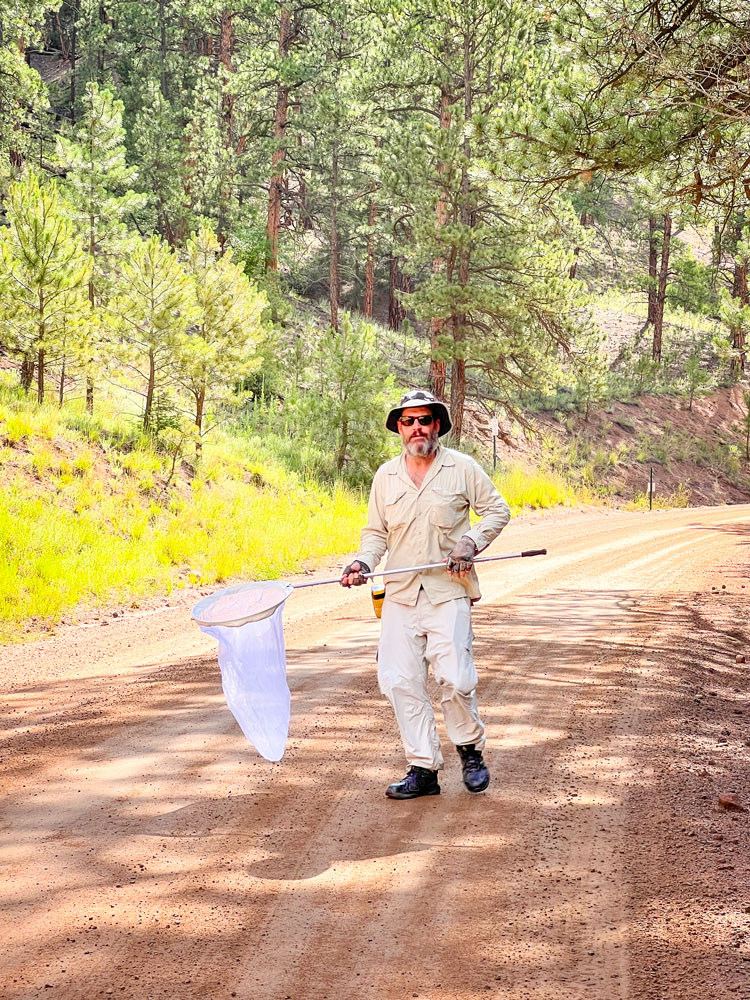
Dr. Andrew Warren last summer along Highway 67 in Douglas County on the hunt for butterflies and moths.
Dr. Andrew “Andy” Warren is an entomologist, but more specifically a lepidopterist, a butterfly and moth expert. He discovered a new genus of moth in 2023 by the shack at the East/West Regional Trail off of Monarch Boulevard. Last summer, Andy’s paper on this moth was published by the Journal of the Lepidopterists’ Society and officially named the moth the Coloradactria frigida.
“This is a really rare find,” shared Andy. “This moth isn’t newly evolved; it is a new species and genus that has been overlooked. It’s like finding something in between a house cat and a tiger in the moth world.”
Andy and his family moved into the first house in the Hidden Pointe neighborhood in 1998. His late mother planted the seed for butterfly study, taking the family on many adventures to collect samples.
Andy attended Cherry Creek High School and as a junior began teaching summertime entomology classes to students ages 5-18. After completing his undergraduate work at Cornell University, Andy went to Oregon State University for eight years where he achieved his doctorate. Then, Andy was a post-doctoral researcher at the National Autonomous University of Mexico, in Mexico City, for two years.
More recently, Andy was the senior collections manager for butterflies and moths at the Florida Museum of Natural History at the University of Florida. He has traveled, collected and studied moths and butterflies from all over the western United States, Mexico, the Caribbean, Central and South America and Kenya. The lion’s share of his research has been on skipper butterflies. In entomology circles, Andy is known as “Lord of the Butterflies,” or sometimes, “The Butterfly Guy.”
In October 2023, Andy left Florida and came home to Colorado to care for his father. On a fateful walk near Monarch Boulevard, Andy noticed some unusual moth activity, which was significant because it was late in the season for moths and after the first snow.
“I saw this little, gray, unfamiliar moth, and I knew I didn’t have it in my collection,” said Andy. He took photos, collected samples, and sent them to a world expert on moths. The expert dissected the moths and replied to Andy that he had only sent male specimens.
Confused, Andy knew he had photographed females and went back to his photos. He realized he had in fact photographed a female but she was on the ground and Andy assumed she had not expanded her wings yet but was about to take flight.
“It turns out, the females do not fly; they run around on the ground like spiders,” Andy explained. “Only the males fly.”
But by this time, December had arrived and the season of this moth was complete. Andy had to wait 11 months (mad at himself, he said) to get a female specimen.
In late 2024, Andy found the moths in great abundance and sent the females to the expert who then sent the legs of the female and male moths to colleagues in Switzerland to run the DNA. And the rest, as they say, is history.
Andy’s research shows that Coloradactria frigida, which averages about 1.4 centimeters – a bit smaller than a dime, is found in mowed areas of sand dropseed, a native grass. During October and November, it is too cold for females to be in the shade so they are found among the shorter, mowed grass because it is warmer ground. Andy speculates that before lawn mowers, these moths relied on the trampled grass from bison, elk and the like.
When Andy is not out exploring with his net, he visits his girlfriend in Florida, who he met on a butterfly research trip in Alaska. She keeps the animals they share: a cat and five turtles. Andy also enjoys gardening, with a focus on native plants that benefit pollinators.
At home, Andy has many specimen drawers resplendent with trays of colorful butterflies, moths and even beetles from around the world. He has donated some to museums and plans to ultimately give his collection to Colorado State University, where Andy is a research associate.
Andy encourages us to go exploring.
“People don’t think about biodiversity very much, but there is undiscovered biodiversity in your back yard,” he concluded. “If you have native vegetation, there are things to be found.”
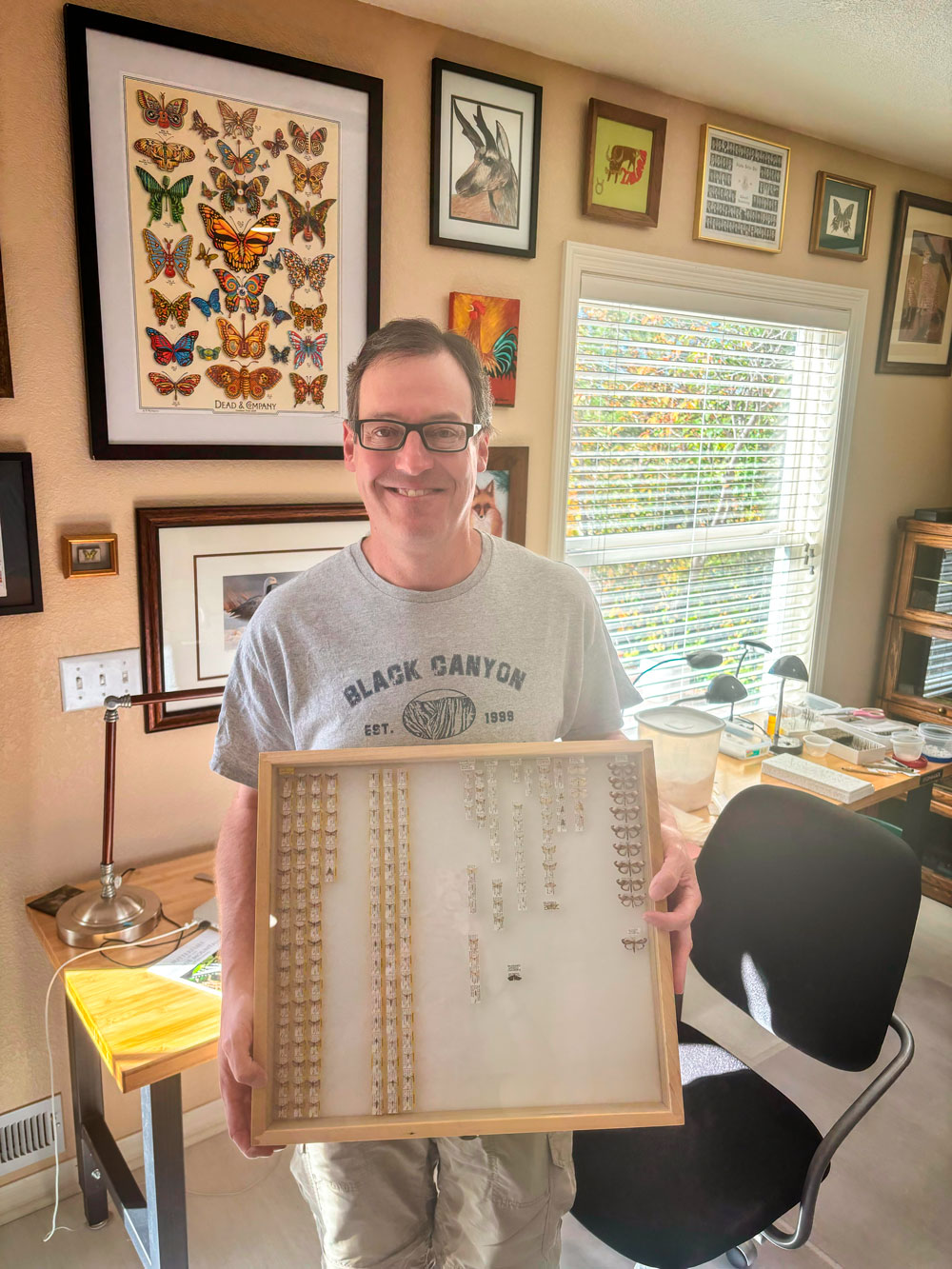
Andy Warren at home in Hidden Pointe holding a drawer of the new genus of moth (left half of drawer, with yellow labels) he discovered along Monarch Boulevard.
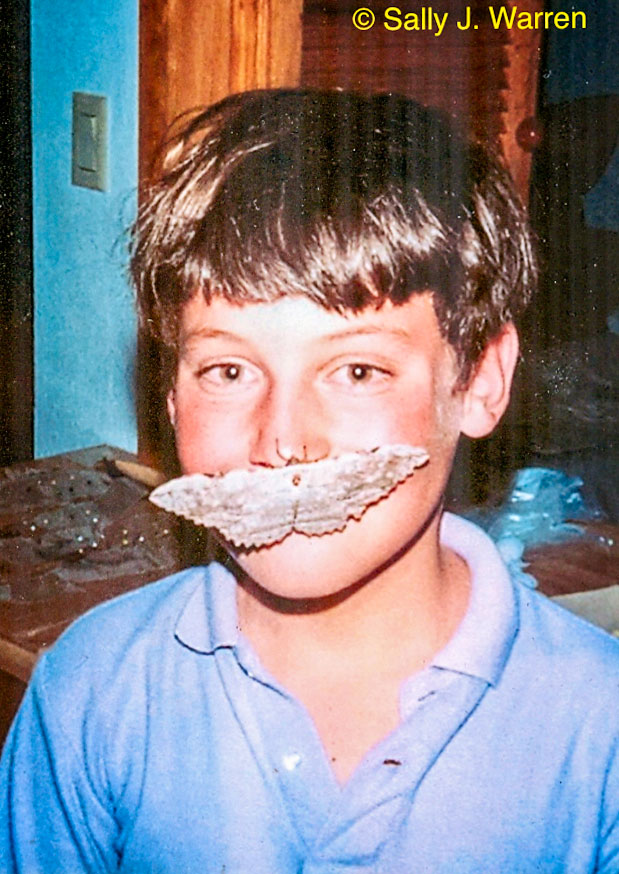
On a butterfly study trip with his mom in 1983, Andy (9) posing with the Owl Moth in Puerto Plata, Dominican Republic. He still has this moth.
Article and photo by Hollen Wheeler; photos courtesy of Adriana Briscoe